

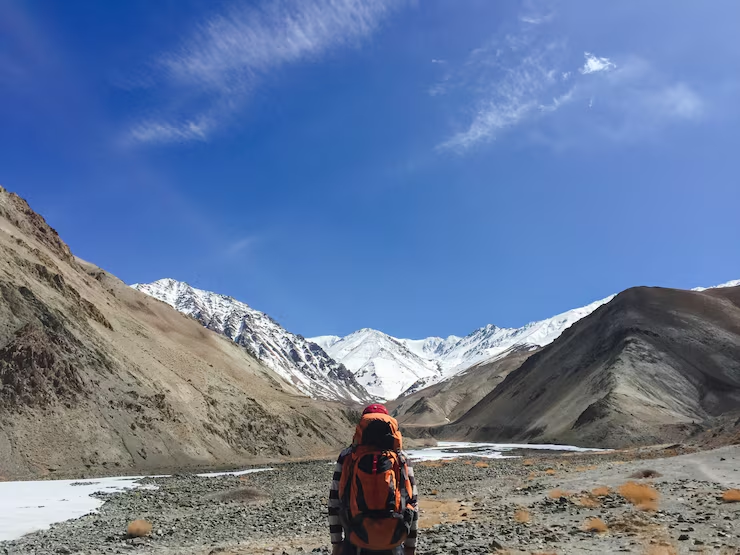
Where is Nepal located and Mount Everest hold a unique and powerful place in global geography, history, and culture. Nepal is known as a land of remarkable natural diversity, ancient civilizations, and spiritual heritage, while Mount Everest stands as the highest point on Earth and a symbol of human ambition and endurance. Understanding where Nepal is located and where Everest is located provides essential context for appreciating their geographical, cultural, and global significance. This article explores both topics in depth, offering a clear and comprehensive explanation suitable for readers seeking accurate and meaningful information.
Where Is Nepal Located?
Nepal is a landlocked country in South Asia, situated between two of the world’s most populous and influential nations: India to the south, east, and west, and China to the north. Specifically, Nepal lies along the southern slopes of the Himalayas, which form a natural boundary between the Tibetan Plateau and the Indian subcontinent.
Geographic Coordinates and Size
Nepal is located approximately between 26° and 31° North latitude and 80° and 88° East longitude. Despite covering a relatively small area—about 147,516 square kilometers—Nepal features extraordinary geographical variation within a short north–south distance of roughly 200 kilometers. This dramatic variation is one of the defining characteristics of the country.
Physical Regions of Nepal
Nepal is commonly divided into three major geographical regions, each with distinct environmental and cultural features:
- The Terai Region
The Terai is a low-lying plain in southern Nepal, bordering India. It is fertile, warm, and agriculturally productive, often referred to as the “granary of Nepal.” This region supports dense populations and significant economic activity.
- The Hill Region
Located between the Terai and the Himalayas, the Hill region consists of rolling hills, valleys, and river basins. Many of Nepal’s major cities, including Kathmandu, are located here. The region is known for its moderate climate, terraced farming, and cultural heritage.
- The Mountain Region
The northernmost part of Nepal contains the high Himalayas, including eight of the world’s fourteen highest peaks. This region is sparsely populated due to harsh climatic conditions but holds immense global importance for mountaineering, tourism, and environmental science.
Strategic and Cultural Location
Nepal’s location has historically made it a cultural bridge between South Asia and East Asia. Influences from Indian civilization and Tibetan culture have blended over centuries, shaping Nepal’s language, religion, architecture, and traditions. The country is especially significant in religious history, as it is the birthplace of Gautama Buddha, born in Lumbini.
Because Nepal does not have direct access to the sea, it relies heavily on its neighbors for international trade routes. Nevertheless, its strategic Himalayan location has allowed it to maintain a distinct national identity throughout history.
Where Is Everest Located?
Mount Everest is located in the Himalayan mountain range, directly on the border between Nepal and China. On the Chinese side, Everest lies within the Tibet Autonomous Region, while on the Nepalese side, it is part of Sagarmatha National Park, a UNESCO World Heritage Site.
Geographic Position and Elevation
Mount Everest stands at an elevation of 8,848.86 meters (29,031.7 feet) above sea level, making it the highest point on the planet. Its precise location places it within the Mahalangur Himal subrange of the greater Himalayas.
The mountain is known by different names depending on cultural perspective:
- In Nepal, it is called Sagarmatha, meaning “Forehead of the Sky.”
- In Tibet, it is known as Chomolungma, meaning “Goddess Mother of the World.”
These names reflect the spiritual and cultural reverence local communities have for the mountain.
Access Routes to Mount Everest
There are two primary routes used by climbers to reach the summit of Everest:
- The South Col Route (Nepal Side)
This is the most commonly used route and begins in Nepal. Climbers typically fly to Lukla and trek through the Khumbu Valley, passing through famous settlements such as Namche Bazaar, before reaching Everest Base Camp.
- The North Ridge Route (China/Tibet Side)
This route approaches Everest from the Tibetan Plateau and is less frequently used due to stricter regulations and more complex logistics.
Geological Significance
Mount Everest’s location is not accidental; it is the result of millions of years of tectonic activity. The ongoing collision between the Indian Plate and the Eurasian Plate continues to push the Himalayas upward by a few millimeters each year. This geological process makes Everest a subject of ongoing scientific study.
Environmental and Cultural Importance
Everest’s location within Nepal places it at the heart of the country’s tourism economy. Thousands of trekkers and climbers visit the region annually, contributing significantly to local livelihoods. At the same time, this popularity has raised concerns about environmental sustainability, waste management, and the preservation of fragile alpine ecosystems.
The Sherpa community, indigenous to the Everest region, plays a vital role in mountaineering expeditions. Their deep knowledge of the terrain and strong cultural ties to the mountains underscore the human dimension of Everest’s location.
The Relationship Between Nepal and Mount Everest
Understanding Where is Everest located helps clarify why Mount Everest is so closely associated with the country. While Everest is shared by Nepal and China, Nepal has become the primary global gateway to the mountain. The southern slopes are more accessible, and Nepal has developed extensive infrastructure to support trekking and climbing.
Everest has also become a symbol of national pride for Nepal. Its image appears in textbooks, tourism campaigns, and international representations of the country. For many people around the world, Nepal and Everest are inseparable concepts.
Conclusion
In summary, Nepal is located in South Asia, nestled between India and China, along the southern edge of the Himalayan mountain range. Despite its small size, Nepal’s geographical diversity and cultural richness make it one of the most distinctive countries in the world. Mount Everest, the highest mountain on Earth, is located in the Himalayas on the border between Nepal and China, with its most famous access routes lying within Nepal.